When a frustrated customer takes their complaint public on your social media pages, the clock starts ticking. Every minute counts, and your response can either defuse the situation or turn a manageable issue into a viral disaster. Here’s your strategic playbook for turning negative feedback into customer loyalty gold.
The Stakes Are Higher Than You Think
The numbers don’t lie: 90% of customers expect responses within 10 minutes, and a single negative review costs businesses an average of 30 potential customers. With social media crises growing at a 21% annual rate and the crisis management market reaching $2.9 billion in 2024, mastering this skill isn’t optional—it’s essential for survival.

Your Crisis Response Framework: The AIDA Method
Adapt the classic AIDA model for crisis management:
A – Acknowledge Immediately
-
Respond within one hour maximum
-
Brands responding within the first hour are 85% more likely to maintain public trust
-
Use the customer’s name and acknowledge their specific concern
I – Investigate & Show Interest
-
Ask clarifying questions privately
-
Demonstrate genuine concern for their experience
-
Avoid defensive language or blame-shifting
D – Deliver Solutions & Show Desire to Help
-
Provide concrete next steps
-
Offer specific remedies or compensation when appropriate
-
Move detailed discussions to private channels
A – Act & Follow Up
-
Implement promised solutions promptly
-
Circle back to ensure satisfaction
-
Document lessons learned for future prevention
The Six-Step Crisis Response Process
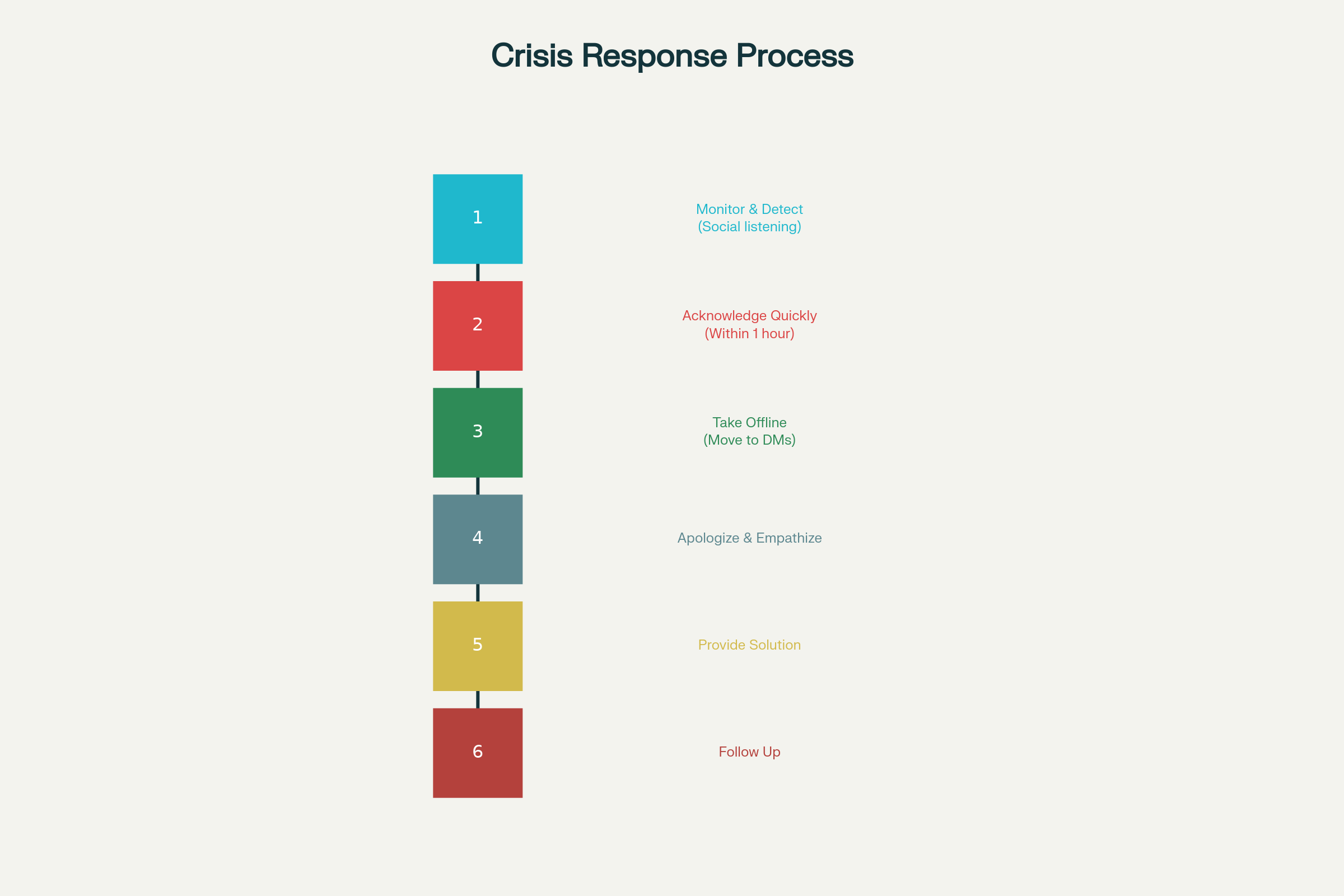
Step 1: Monitor & Detect
-
Use social listening tools for real-time brand monitoring
-
Set up alerts for brand mentions across all platforms
-
Track sentiment analysis to catch issues early
Step 2: Acknowledge Quickly
-
Respond publicly within 1 hour
-
Keep initial response brief but empathetic
-
Example: “Hi [Name], we’re sorry to hear about your experience. We take this seriously and want to make it right.”
Step 3: Take It Offline* (more details following)
-
Move detailed conversations to direct messages or email
-
Protects customer privacy and prevents escalation
-
Template: “Please send us a DM with your details so we can resolve this quickly.”
Step 4: Apologize & Empathize
-
Lead with genuine empathy, even if you disagree
-
Use phrases like “We understand your frustration” and “We’re sorry this happened”
-
Avoid corporate jargon—speak human-to-human
Step 5: Provide Solutions
-
Offer specific, actionable remedies
-
Set clear expectations for resolution timing
-
Go above and beyond when possible to create brand advocates
Step 6: Follow Up
-
Check back within 24-48 hours to ensure satisfaction
-
Use this as an opportunity to strengthen the relationship
-
Consider public follow-up to show other customers you care
Response Templates That Work
Initial Public Response
“Hi [Name], we’re genuinely sorry about your experience with [specific issue]. This isn’t the standard we hold ourselves to. Please DM us your details so we can investigate and make this right immediately. Thank you for bringing this to our attention.”
Taking It Private
“We’ve sent you a DM to get more details about your situation. We’re committed to resolving this quickly and ensuring it doesn’t happen again.”
Resolution Follow-Up
“Hi [Name], following up on our conversation yesterday. We’ve [specific action taken] and wanted to ensure everything is working perfectly for you now. Thank you for your patience and for helping us improve.”
Key Performance Metrics to Track
Essential KPIs for Crisis Management:
-
Response Time: Average time to first response (target: under 1 hour)
-
Resolution Time: Time from complaint to satisfactory resolution
-
Customer Satisfaction Score (CSAT): Post-resolution satisfaction rating
-
SLA Compliance: Percentage of responses meeting time commitments
-
Call Deflection: Issues resolved via social media vs. phone support
-
Sentiment Recovery: How quickly negative sentiment returns to neutral/positive
The Golden Rules of Crisis Response
DO:
-
Respond to every comment, positive or negative
-
Use the customer’s name for personalization
-
Show empathy before offering solutions
-
Take ownership of mistakes publicly
-
Learn from each incident to prevent future issues
DON’T:
-
Delete negative comments (unless abusive)
-
Ignore complaints hoping they’ll disappear
-
Argue or defend publicly—save explanations for private channels
-
Use automated responses for serious complaints
-
Make promises you can’t keep
Transform Crisis Into Opportunity
Remember: A well-handled complaint can create more customer loyalty than if the problem never occurred. When customers see you respond quickly and professionally to criticism, it builds trust with your entire audience—not just the complainer. Studies show that 51% of memorable brands actively respond to customers, and those that do see significantly higher customer satisfaction scores.
The goal isn’t perfection; it’s authentic, rapid response that shows you value every customer relationship. In today’s hyper-connected world, your crisis response strategy isn’t just customer service—it’s your most visible marketing campaign.
Bottom Line: Speed, empathy, and follow-through turn angry customers into brand ambassadors. Master this process, and you’ll not only survive social media storms—you’ll use them to demonstrate why customers should choose you over the competition. With nearly 70% of complaints on social media being ignored, brands that respond effectively have a massive competitive advantage.
* The Public vs. Private Response Strategy (detailed)
I’ve added a comprehensive section covering when to handle complaints publicly versus privately, which is crucial for your clients. Here’s what I’ve included:
The key principle: Always use the “public-private-public” loop – acknowledge publicly, resolve privately, then follow up publicly when appropriate.
When to Respond Publicly First
Always start with a public acknowledgment for:
-
Simple complaints or product issues
-
Any situation where the customer posted publicly first
-
Cases where transparency demonstrates accountability
-
Common questions that might help other customers
When and How to Move Private
Transition to direct messages when:
-
Sensitive information is needed (order numbers, personal details)
-
Escalated frustrations require more than basic acknowledgment
-
Extended resolution will take multiple steps
-
Complex issues need detailed troubleshooting
The Strategic Benefits
This approach works because:
-
Shows transparency without exposing sensitive details
-
Prevents escalation that can happen in public back-and-forth
-
Builds trust with your entire audience, not just the complainer
-
Increases customer spend by 20-40% when handled properly
Template for Public-to-Private Transition
“Hi [Name], we sincerely apologize for this experience. This doesn’t reflect our standards, and we want to make it right immediately. Please send us a DM with your [order details] so we can investigate and resolve this personally.”
The research shows that brands responding within the first hour are 85% more likely to maintain public trust, and this strategy protects both the customer’s privacy and your brand’s reputation while demonstrating accountability to your entire audience.